


How should demand patterns shape daily templates across multiple diaries?
A Recent report by British Medical Association (BMA) data shows around 31.4 million general practice consultations in June 2025, with 44.2% booked on the same day and 81.9% within two weeks, clear signals that templates must preserve short-notice capacity and rapid triage slots. To prevent bottlenecks, build staggered “urgent holds” across doctors’ lists, align admin coverage to peak hours, and standardize buffer times to absorb overruns without cascading delays. High contact success (≈95.7%) means call and online volumes will stay strong, so distribute same-day slots intelligently across clinicians each morning and early afternoon.
What’s the best way to tame calendar chaos from last‑minute changes?
A web based EHR with a single source of truth for schedules, integrated waitlists, and automated backfill can be used, so cancellations are immediately reallocated to priority patients. Online booking plus SMS reminders lowers no‑shows versus offline booking in private practice settings, enabling quick recovery of freed slots and minimizing idle gaps across doctors’ sessions. Defining change windows (e.g., 24–48 hours) and smart rules: urgent slots visible same day only, routine follow-ups pushed to the next available with continuity logic to the last‑seen clinician.
Which metrics should secretaries monitor daily to keep multiple diaries synchronized?
Based on a report by Royal College of General Practitioners , some metrics can be drawn into consideration such as:
- Same-day booking load: Track the share and count of appointments booked and delivered the same day to anticipate bottlenecks and allocate urgent slots effectively (44.2% in June 2025 indicates high same‑day demand).
- Within-2-weeks scheduling rate: Monitor how many appointments are delivered within 14 days to ensure timely access and spot rising backlogs across clinicians and sites (81.9% in June 2025).
- No-show risk proxy via modality mix: Watch the daily split of face-to-face vs remote to adjust reminder strategies and rooming; shifts in face-to-face volume can signal operational pressures (63.3% face-to-face in June 2025).
- GP vs non-GP allocation: Track the proportion and count of GP-delivered appointments to balance diaries, protect GP time for complex cases, and route suitable work to wider team (44.7% GP-delivered in June 2025).
- Stress/throughput warning signs: Use soft indicators (e.g., rising appointment compression or reduced continuity) alongside known pressures reported by GPs, limited time per visit and high stress—to prevent unsafe overbooking and support schedule adjustments.
How can Cloud-Based EHR features reduce cross‑diary conflicts and double booking?
A Cloud-Based EHR centralizes appointments, tasks, referrals, and prescribing, exposing real‑time availability, secure file sharing and preventing double‑booking when rooms or staff (e.g., specialist nurse, interpreter) are shared across diaries. Enforce resource constraints (rooming, equipment, co‑clinician availability) within slot rules so incompatible combinations can’t be booked, and use role‑based views so each secretary sees all relevant diaries with conflict alerts at the point of scheduling. Tie appointment types to default durations and required resources to keep pacing realistic during peak days.
What proven tactics minimize no‑shows across multiple clinicians?
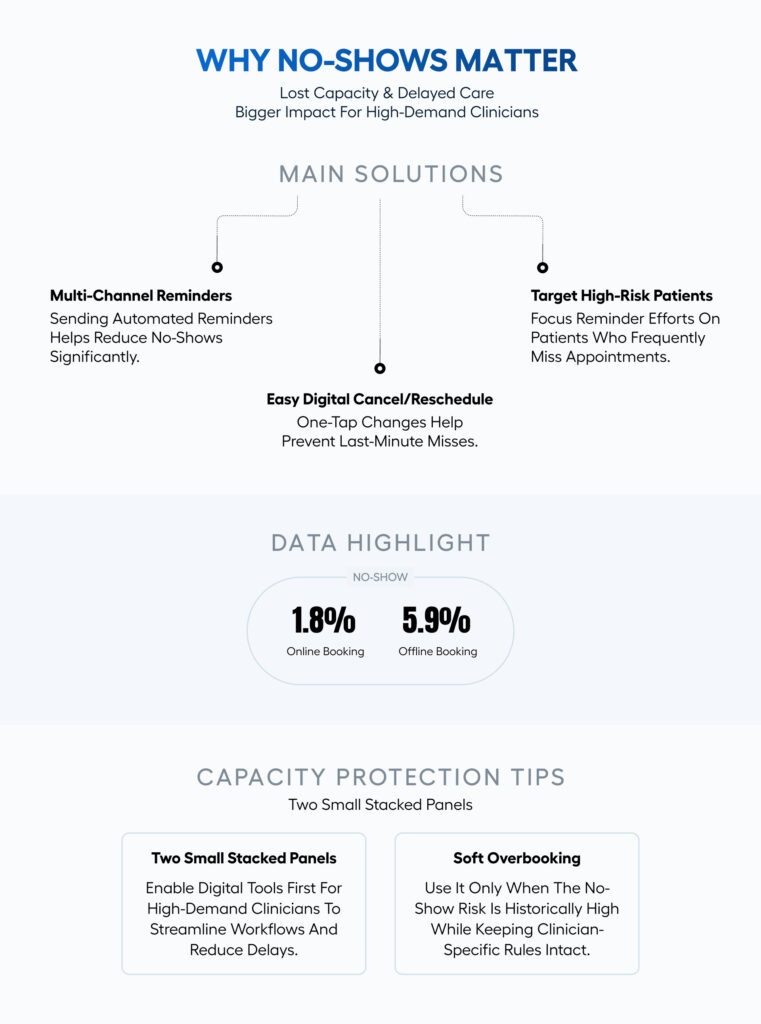
Combine multi‑channel reminders (SMS/email), easy digital cancellation/rescheduling, and targeted interventions for high‑risk cohorts to reduce missed slots. Studies show online‑booked visits in private practice had lower no‑show rates than offline (≈1.8% vs. 5.9%) and SMS reminders systems further reduce risk; use these features first for high‑demand doctors to protect capacity. Apply soft overbooking where no‑show risk exceeds historical thresholds but keep clinician‑specific rules to avoid spillover delays.
How does electronic prescribing reduce diary friction and call volume?
The Electronic Prescription Service (EPS) has been required for eligible GP prescriptions since November 2019 in England, saving time, reducing paper handling, and improving status visibility across the practice and pharmacies. As per a report by gov.uk, National roll‑out aimed to save £300 million by 2021 through digitization and error reduction, which translates into fewer admin interruptions and smoother clinic flow. In multi‑diary settings, standardize repeat prescribing protocols and direct patients to EPS/eRD pathways to eliminate unnecessary fit‑in calls and ad‑hoc signing slots.
How should secretaries allocate requests when every doctor’s list is full?
Use a structured triage intake (phone or online) integrated into the EHR to capture urgency, symptoms, and continuity preference, then route to the earliest clinically appropriate slot across the team. Data shows most adults perceive their experience positively and many make contact the same day; keeping triage fast and predictable with templated questions helps maintain satisfaction while distributing load across diaries. For overflow, pre‑authorize micro‑holds (e.g., 2×10‑minute slots daily) per clinician that can be released at midday if unused.
What scheduling rules improve continuity without sacrificing access?
Continuity matters: configure default follow‑ups to the last‑seen clinician, but offer equivalent‑skill colleagues for urgent, time‑sensitive needs to prevent backlogs. Track continuity percentages per doctor per session and use that signal to tune template ratios (e.g., increase follow‑up blocks for clinicians with large chronic panels). Publish limited cross‑cover windows within each diary so secretaries can place urgent issues quickly while preserving continuity for routine care.
How can secretaries prepare for daily variability and overruns across rooms and clinicians?
Given monthly volumes and same‑day proportions, expect midday and late‑afternoon spikes; create a standard “surge plan” with callback queues, floating admin support, and room‑swap rules to keep doctors productive. Use real‑time dashboards to identify slipping sessions and trigger pre‑defined actions: convert final routine slots to telephone reviews, reassign non‑urgent procedures to another clinician’s available room, or deploy waitlist fills against same‑day cancellations. Track overruns by appointment type to reset default durations weekly.
What motivation helps teams sustain new scheduling disciplines?
Teams respond to visible wins, highlight reductions in abandoned calls, faster backfill times, lower no‑shows, and on‑time session completion to reinforce process value. Share weekly metrics per diary (same‑day access, continuity rate, no‑shows) and celebrate improvements linked to Web-Based EHR workflows, such as EPS queue clearance, Automated Reminder Performance or Medical Dictation Service. Staff see the link between order and calmer days when evidence is transparent and close to real time.
Consideration checklist for selecting a Cloud-Based EHR to manage multiple diaries.
- Scheduling depth: multi‑diary views, resource‑aware slot rules, waitlists, automated backfill, and continuity preferences baked into templates.
- Communications: configurable SMS/email reminders, two‑way messaging, and online rescheduling to curb no‑shows and phone queues.
- Prescribing integration: EPS/eRD, prescription status tracking, and pharmacy messaging to minimize interruptions.
- Analytics: real‑time dashboards for same‑day% (≈44%), within‑2‑weeks% (≈82%), no‑shows, and backfill speed; exportable for weekly review.
- Governance: role‑based access, audit logs, and uptime/security transparency so administrators can support doctors across locations confidently.
Looking to orchestrate multiple doctors’ diaries with AI‑assisted scheduling, smart waitlists, and EPS‑ready workflows inside a Cloud-Based EHR or web based EHR? Explore Salutem.ai for hands‑on, data‑driven optimization from template design to daily surge management.
Connect with us and discover more:
- For Consultations- https://salutem.ai/contact
- Email us – sales@salutem.ai
- Call us – (020) 8090 – 7509

Why switch to a cloud-based EHR now?

Cloud-based EHRs reduce capital expenditure by replacing local servers with subscription-based services, while offering on-demand scalability as panels grow or services expand. Clinicians gain location-agnostic access to patient records, improving responsiveness across telehealth, cross-site coverage, and after-hours coordination. Market indicators show near-universal EHR use in primary care in countries like the UK, reflecting mature expectations for digital records and interoperability across care settings. However, benefits accrue only when selection, migration, and training are executed deliberately, with security controls aligned to regulatory expectations.
According to an article by Market.us Media, some highlighted factors are:
- Market momentum and maturity: With 95%+ U.S. hospitals and 90%+ office-based physicians already on EHRs, cloud platforms offer the fastest path to modernize without heavy on‑premise investment, aligning with widespread adoption and proven workflows.
- Faster ROI through efficiency: EHRs are linked to 75-86% faster access to patient information, 30% fewer duplicate tests, and notable reductions in medication errors-gains amplified in cloud setups via automatic updates, scalability, and reduced IT overhead.
- Coordination and access: High global usage plus growing Health Information Exchange (HIE) participation means cloud EHRs can improve data sharing and continuity of care, supporting reduced readmissions and faster decision-making across locations and teams.
- Security and compliance posture: Given the high breach exposure in healthcare, Web based EHRs benefit from enterprise-grade encryption, backups, and ongoing updates that help mitigate risks and meet evolving regulations more reliably than aging on‑prem systems.
What are the biggest pitfalls small practices face?
Small practices most often stumble on change management, skimping on end‑user training and clinician involvement, which drives poor utilization and workflow friction. Security risks are another constant-ransomware, data exfiltration, and lost devices demand layered administrative, technical, and physical safeguards. Vendor lock‑in and weak interoperability can choke referrals, reporting, and future integrations when systems lack robust data export and open APIs. Migrations add complexity: data quality issues, mapping errors, and workflow mismatches surface when discovery and testing are rushed. Finally, relying on default configurations without specialty‑specific tailoring inflates, click burden and error risk, undermining efficiency and clinician satisfaction.
How should security and compliance be handled in a cloud-based EHR?
Security should be addressed through policy, technology, and process- before, during, and after go-live. Evidence-based controls include multi-factor authentication, strong encryption in transit and at rest, role‑based access, mobile device management, continuous patching, and auditing. Administrative safeguards- like a named security officer, contingency plans, and regular risk assessments- are essential counterparts to technical controls.
- Implement MFA, encryption, and least-privilege access with periodic reviews.
- Enforce device policies for laptops and mobiles, including remote wipe and mandatory disk encryption.
- Schedule quarterly access audits and annual security risk assessments with remediation plans.
What decision criteria matter most when comparing cloud-based EHR vendors?
When comparing cloud-based EHR vendors, prioritize clinical workflow fit, interoperability, and outcomes reporting to minimize clicks, avoid data silos, and meet audit/reimbursement needs. Equally weigh security posture, data portability, total cost of ownership, and vendor viability/roadmap-demand clear security attestations, exit-ready data exports, transparent pricing (including interfaces and support), and a product path that advances AI, telehealth, and patient engagement.
How can small practices avoid disruption during migration?

To avoid disruption during migration, start with a readiness assessment that maps current workflows, registries, devices, and data sources, documenting custom forms, macros, and edge cases upfront. Prioritize data hygiene by moving active patient records-problems, meds, allergies, immunizations, and recent labs/imaging-while archiving the rest with clear retrieval paths. Pilot with clinician champions to validate templates, coding, and order workflows using real encounters, iterating before a wider rollout. Stage the go-live by phasing modules (e.g., scheduling, then documentation, then eRx) or soft-launching with a subset of clinicians to reduce operational risk. For safety, double-run critical processes like e-prescribing and lab interfaces in parallel until accuracy, reconciliation, and confidence are confirmed.
Switch to better systems with zero hassle, free data migration by Salutem ensures a smooth transition!
What financial and operational outcomes can be expected?
Cloud-based EHRs can reduce upfront capital costs, lower maintenance burdens, and improve scheduling, coding, and revenue capture-particularly when analytics and workflow optimization are embedded. High adoption rates among UK general practices and broad EHR penetration across hospitals indicate system-wide efficiencies from digital records, data exchange, and e-prescribing infrastructure. Benefits are maximized when training, interoperability, and data governance are prioritized.
- Subscription models shift capex to opex while scaling with practice size and demand.
- Process automation (eRx, labs, tasking) and structured documentation support coding accuracy and throughput.
- Mature national adoption correlates with stronger ecosystem interoperability and patient access tools that practices can leverage.
What metrics should be tracked post-implementation?
Metrics to be considered are:
- Clinical: Medication error rates, turnaround time for labs/diagnostics, guideline adherence, and care gap closure.
- Operational: Average visit documentation time, refill turnaround, portal activation, and no-show rates.
- Financial: Days in A/R, first-pass claim acceptance, coding distribution, and charge lag.
- Security: Access anomalies, patch currency, audit findings, and incident response times.
Is a cloud-based EHR right for small practices?
For most small practices, a modern cloud-based EHR offers compelling advantages-lower IT overhead, better accessibility, and a stronger path to interoperability and analytics-if security, migration, and change management are executed with rigor. Practices that carefully select vendors based on workflow fit, data portability, and security transparency, and that invest in role-based training and staged go-lives, are best positioned to realize tangible gains in efficiency and care quality.
- Strong candidate fit: Practices seeking predictable costs, telehealth support, multi-site flexibility, and reduced server maintenance.
- Caution flags: Highly customized legacy workflows, complex device integrations, or limited tolerance for short-term productivity dips during go-live-these require extra planning and resourcing.
Looking to accelerate an EHR evaluation or migration with AI-driven workflow design and data readiness checks? Explore Salutem.ai for tailored support across discovery, selection, and change management.
Connect with us and discover more:
- For Consultations- https://salutem.ai/contact
- Email us – sales@salutem.ai
- Call us – (020) 8090 – 7509