


Electronic Health Record
Top Trending Strategies for Managing Multiple Doctors Diaries Efficiently
5 December 2025

Coordinating multiple clinicians’ calendars is high-stakes, high-velocity work: appointment demand is heavy, same-day requests are common, and patient contact volumes are consistently high, conditions that can quickly create calendar chaos without the right processes and tools in place. A Cloud-Based EHR or Web Based EHR can centralize scheduling, triage, communication, and prescribing, reduce fragmentation and help secretaries maintain control across competing priorities. Below are practical, question-led strategies, using current UK data and research, to help streamline multi‑diary management in private practice.
How should demand patterns shape daily templates across multiple diaries?
A Recent report by British Medical Association (BMA) data shows around 31.4 million general practice consultations in June 2025, with 44.2% booked on the same day and 81.9% within two weeks, clear signals that templates must preserve short-notice capacity and rapid triage slots. To prevent bottlenecks, build staggered “urgent holds” across doctors’ lists, align admin coverage to peak hours, and standardize buffer times to absorb overruns without cascading delays. High contact success (≈95.7%) means call and online volumes will stay strong, so distribute same-day slots intelligently across clinicians each morning and early afternoon.
What’s the best way to tame calendar chaos from last‑minute changes?
A web based EHR with a single source of truth for schedules, integrated waitlists, and automated backfill can be used, so cancellations are immediately reallocated to priority patients. Online booking plus SMS reminders lowers no‑shows versus offline booking in private practice settings, enabling quick recovery of freed slots and minimizing idle gaps across doctors’ sessions. Defining change windows (e.g., 24–48 hours) and smart rules: urgent slots visible same day only, routine follow-ups pushed to the next available with continuity logic to the last‑seen clinician.
Which metrics should secretaries monitor daily to keep multiple diaries synchronized?
Based on a report by Royal College of General Practitioners , some metrics can be drawn into consideration such as:
- Same-day booking load: Track the share and count of appointments booked and delivered the same day to anticipate bottlenecks and allocate urgent slots effectively (44.2% in June 2025 indicates high same‑day demand).
- Within-2-weeks scheduling rate: Monitor how many appointments are delivered within 14 days to ensure timely access and spot rising backlogs across clinicians and sites (81.9% in June 2025).
- No-show risk proxy via modality mix: Watch the daily split of face-to-face vs remote to adjust reminder strategies and rooming; shifts in face-to-face volume can signal operational pressures (63.3% face-to-face in June 2025).
- GP vs non-GP allocation: Track the proportion and count of GP-delivered appointments to balance diaries, protect GP time for complex cases, and route suitable work to wider team (44.7% GP-delivered in June 2025).
- Stress/throughput warning signs: Use soft indicators (e.g., rising appointment compression or reduced continuity) alongside known pressures reported by GPs, limited time per visit and high stress—to prevent unsafe overbooking and support schedule adjustments.
How can Cloud-Based EHR features reduce cross‑diary conflicts and double booking?
A Cloud-Based EHR centralizes appointments, tasks, referrals, and prescribing, exposing real‑time availability, secure file sharing and preventing double‑booking when rooms or staff (e.g., specialist nurse, interpreter) are shared across diaries. Enforce resource constraints (rooming, equipment, co‑clinician availability) within slot rules so incompatible combinations can’t be booked, and use role‑based views so each secretary sees all relevant diaries with conflict alerts at the point of scheduling. Tie appointment types to default durations and required resources to keep pacing realistic during peak days.
What proven tactics minimize no‑shows across multiple clinicians?
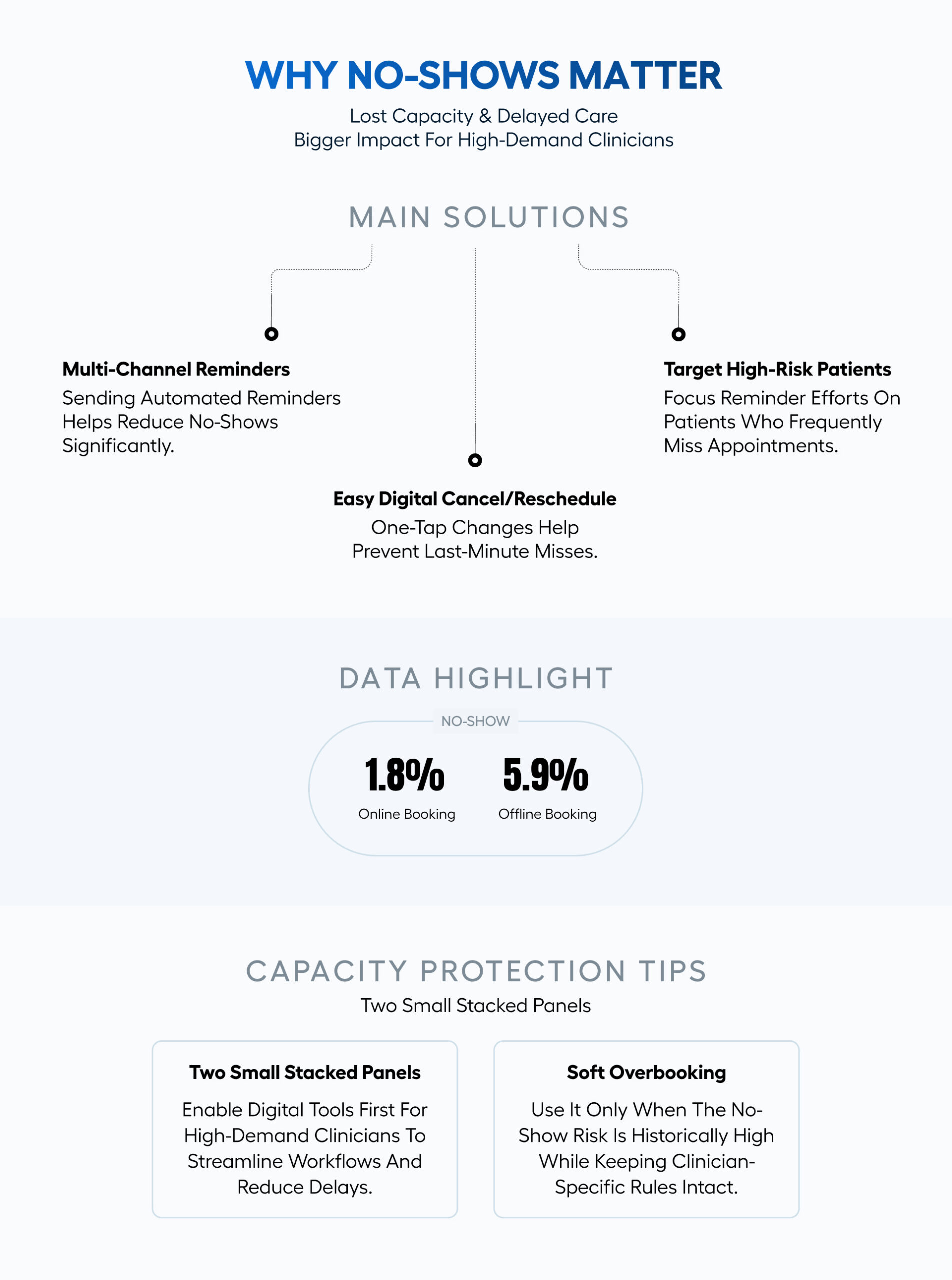
Combine multi‑channel reminders (SMS/email), easy digital cancellation/rescheduling, and targeted interventions for high‑risk cohorts to reduce missed slots. Studies show online‑booked visits in private practice had lower no‑show rates than offline (≈1.8% vs. 5.9%) and SMS reminders systems further reduce risk; use these features first for high‑demand doctors to protect capacity. Apply soft overbooking where no‑show risk exceeds historical thresholds but keep clinician‑specific rules to avoid spillover delays.
How does electronic prescribing reduce diary friction and call volume?
The Electronic Prescription Service (EPS) has been required for eligible GP prescriptions since November 2019 in England, saving time, reducing paper handling, and improving status visibility across the practice and pharmacies. As per a report by gov.uk, National roll‑out aimed to save £300 million by 2021 through digitization and error reduction, which translates into fewer admin interruptions and smoother clinic flow. In multi‑diary settings, standardize repeat prescribing protocols and direct patients to EPS/eRD pathways to eliminate unnecessary fit‑in calls and ad‑hoc signing slots.
How should secretaries allocate requests when every doctor’s list is full?
Use a structured triage intake (phone or online) integrated into the EHR to capture urgency, symptoms, and continuity preference, then route to the earliest clinically appropriate slot across the team. Data shows most adults perceive their experience positively and many make contact the same day; keeping triage fast and predictable with templated questions helps maintain satisfaction while distributing load across diaries. For overflow, pre‑authorize micro‑holds (e.g., 2×10‑minute slots daily) per clinician that can be released at midday if unused.
What scheduling rules improve continuity without sacrificing access?
Continuity matters: configure default follow‑ups to the last‑seen clinician, but offer equivalent‑skill colleagues for urgent, time‑sensitive needs to prevent backlogs. Track continuity percentages per doctor per session and use that signal to tune template ratios (e.g., increase follow‑up blocks for clinicians with large chronic panels). Publish limited cross‑cover windows within each diary so secretaries can place urgent issues quickly while preserving continuity for routine care.
How can secretaries prepare for daily variability and overruns across rooms and clinicians?
Given monthly volumes and same‑day proportions, expect midday and late‑afternoon spikes; create a standard “surge plan” with callback queues, floating admin support, and room‑swap rules to keep doctors productive. Use real‑time dashboards to identify slipping sessions and trigger pre‑defined actions: convert final routine slots to telephone reviews, reassign non‑urgent procedures to another clinician’s available room, or deploy waitlist fills against same‑day cancellations. Track overruns by appointment type to reset default durations weekly.
What motivation helps teams sustain new scheduling disciplines?
Teams respond to visible wins, highlight reductions in abandoned calls, faster backfill times, lower no‑shows, and on‑time session completion to reinforce process value. Share weekly metrics per diary (same‑day access, continuity rate, no‑shows) and celebrate improvements linked to Web-Based EHR workflows, such as EPS queue clearance, Automated Reminder Performance or Medical Dictation Service. Staff see the link between order and calmer days when evidence is transparent and close to real time.
Consideration checklist for selecting a Cloud-Based EHR to manage multiple diaries.
- Scheduling depth: multi‑diary views, resource‑aware slot rules, waitlists, automated backfill, and continuity preferences baked into templates.
- Communications: configurable SMS/email reminders, two‑way messaging, and online rescheduling to curb no‑shows and phone queues.
- Prescribing integration: EPS/eRD, prescription status tracking, and pharmacy messaging to minimize interruptions.
- Analytics: real‑time dashboards for same‑day% (≈44%), within‑2‑weeks% (≈82%), no‑shows, and backfill speed; exportable for weekly review.
- Governance: role‑based access, audit logs, and uptime/security transparency so administrators can support doctors across locations confidently.
Looking to orchestrate multiple doctors’ diaries with AI‑assisted scheduling, smart waitlists, and EPS‑ready workflows inside a Cloud-Based EHR or web based EHR? Explore Salutem.ai for hands‑on, data‑driven optimization from template design to daily surge management.
Connect with us and discover more:
- For Consultations- https://salutem.ai/contact
- Email us - sales@salutem.ai
- Call us - (020) 8090 – 7509


sub heading
Teams respond to visible wins, highlight reductions in abandoned calls, faster backfill times, lower no‑shows, and on‑time session completion to reinforce process value. Share weekly metrics per diary (same‑day access, continuity rate, no‑shows) and celebrate improvements linked to Web-Based EHR workflows, such as EPS queue clearance, Automated Reminder Performance or Medical Dictation Service. Staff see the link between order and calmer days when evidence is transparent and close to real time.
You may also like..



Subscribe to Maillist!
Subscribe to the Salutem newsletter to recieve the latest article insights to your inbox