


Electronic Health Record, Healthcare, Patient Appointment Scheduling
How to Reduce Patient No-Shows with Smart Scheduling Tools
2 February 2026

Patient no-shows remain one of the most persistent challenges in healthcare, impacting both the quality of care and the financial stability of practices. The adoption of Advanced Patient Appointment Management Systems, especially those integrated with EHR (Electronic Health Record) solutions, offers healthcare providers critical tools to minimize missed appointments and streamline the patient experience. This comprehensive guide explores data-driven strategies and the latest technologies to curb no-shows, improve practice efficiency, and foster stronger provider-patient relationships.
Data & Impact for the Real Cost of Patient No-Shows
Patient no-shows represent a significant operational and financial challenge for healthcare providers, with impacts that extend beyond lost revenue. Understanding the scope, underlying causes, and demographic patterns of no-shows is an essential step toward implementing effective patient appointment management strategies and optimizing both patient satisfaction and practice performance. Here’s the data for reference:
Prevalence - According to a report by National Library of Medicine, Patient no-show rates in the U.S. vary widely, averaging between 5.5% and 50%, with a global average at 23.5%. Outpatient specialties often face rates from 23% to 33%, and some clinics even report 80% in specific contexts. Recent Trends - Over half of medical groups have seen patient no-show rates increase in recent years, even with widespread use of basic reminders. Demographics - According to an article by BMC Health Services Research, the highest no-show rates are among patients aged 21-30 (11.84%), with a decline as patient age increases; those over 60 have the lowest no-show rate at just 2.86%. Appointment Lead Time - An article by BMC Health Services Research gives insights on Appointments booked >60 days out see a 7.7% no-show rate, while those within 0–15 days are missed only 4.3% of the time. Financial Impact- As per a report by National Library of Medicine the avg no-show rate was about 18.8%, highest in subspecialist and women’s clinics, and lowest in geriatric care. Despite phone reminders, no-shows remained frequent, costing an average of $196 per missed appointment.
Why Do Patients Miss Appointments?
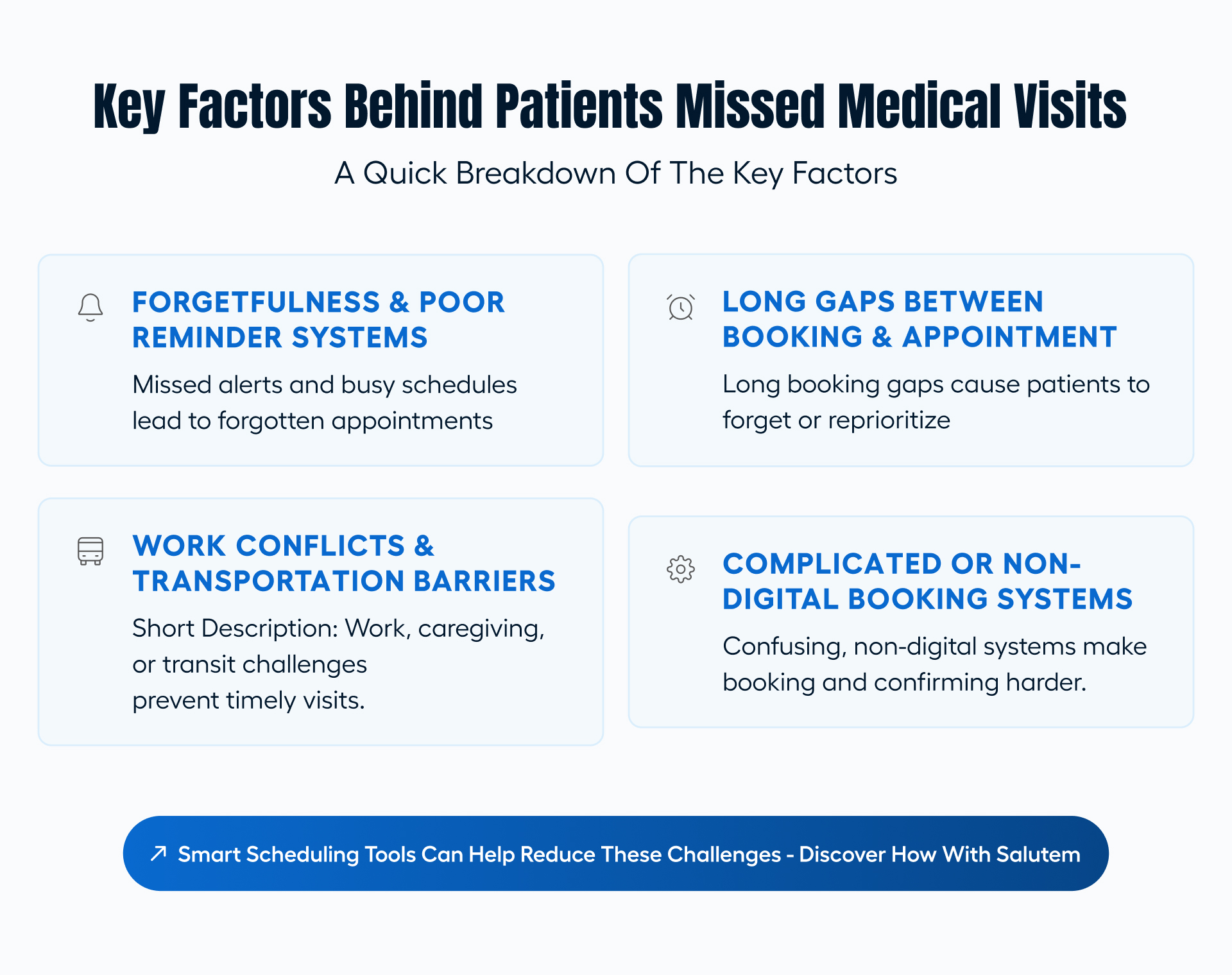
Patient no-shows are a pervasive issue in healthcare settings, caused by a variety of factors that often intertwine. Understanding these underlying reasons is critical for healthcare providers aiming to reduce missed appointments and improve patient care delivery. The causes range from patient behavior and external circumstances to systemic inefficiencies in scheduling processes. Below is a detailed exploration of the primary reasons patients fail to keep their appointments:
- Forgetfulness or Lack of Reminders: Busy lives and absent/untimely reminders lead to missed visits; automated, personalized SMS/email/call prompts cut no-shows.
- Long Wait Times for Appointments: Weeks-long gaps increase forgetfulness, changing priorities, and drop-offs; shorter lead times and flexible slots improve attendance.
- Scheduling Conflicts and Transportation Issues: Work, caregiving, and mobility/transit barriers derail visits; easy rescheduling and support options reduce unavoidable misses.
- Complex or Outdated Scheduling Processes: Multi-call, confusing, or non-mobile systems deter booking and confirmations; self-service, real-time, mobile-friendly tools boost adherence.
How Smart Scheduling Tools Minimize Patient No-Shows?
Modern Patient Appointment Management Systems, especially those with EHR integration and artificial intelligence, employ a variety of features to significantly reduce missed appointments. These tools not only automate communication with patients but also adapt to scheduling processes based on real-time data and predictive insights.
- Automated and Personal Reminders: Multichannel SMS, email, voice, app nudges with one-tap confirm/reschedule; frequency adapts to patient preferences and no-show risk.
- Self-Scheduling and Real-Time Booking: 24/7 portals, apps show live availability; patients book, confirm, change anytime, backfilling last-minute slots.
- EHR-Integrated Scheduling: Pulls demographics, history, preferences to tailor slots and automate follow-ups; reduces double-bookings and admin errors.
- Advanced Analytics and AI Predictions: Flags high-risk no-shows for extra outreach; dashboards reveal patterns by time, specialty, or lead time to refine rules.
- Multichannel, Two-Way Patient Engagement: Mobile-first flows and reply-to-confirm messaging remove phone tags, raising confirmation rates and lowering friction.
Trending Key Features to look for in for a Patient Appointment Management System
A Patient Appointment Management System should be able to help healthcare providers and their staff efficiently manage bookings, avoid scheduling conflicts, and save time. Here are the trending key features to investigate for selecting a Patient Appointment Management System:
- Sync with External Calendars: Integrates with Google Calendar and Outlook Calendar so schedules stay aligned, and conflicts are avoided.
- Automated Appointment Reminders: Sends SMS, WhatsApp, email, app alerts to cut no-shows and save staff time.
- Seamless Patient Management – Experience streamlined care delivery through efficient and intuitive patient data handling.
- Centralized Health Records – Access to complete patient histories, reports, and prescriptions securely from a single platform.
- Role-Based Access Control – Maintain data confidentiality by assigning permissions according to staff responsibilities.
- Simplified Front-Desk Operations – Accelerate registration and check-in with user-friendly digital tools.
- Teleconsultation Capabilities – Extend healthcare reach beyond boundaries with secure virtual consultations.
- Smart Documentation Tools – Record consultation notes faster through speech-to-text dictation and transcription features.
- Effortless Communication & Correspondence – Generate and send medical letters, reports, and prescriptions with automated templates and secure delivery.
- Comprehensive Billing & Claims – Simplify financial workflows through automated claim submissions and real-time payment tracking.
- Regulatory Compliance & Data Security – Ensure adherence to healthcare standards like HIPAA, HL7, and ICD-10, with robust encryption and compliance checks.
Actionable Steps for Healthcare Practices: In-Depth Guide
A targeted, data-driven approach can significantly cut patient no-shows and improve scheduling efficiency in healthcare practices. This in-depth guide outlines practical steps - covering audit, technology, workflows, and staff training:
Audit Your No-Show Rate (by Age, Specialty, Lead Time)
- Segment no-shows by age, specialty, and booking lead time to spot high-risk groups.
- Benchmark current rates and set targets; shorten booking windows for high-risk cohorts.
Adopt an EHR-Integrated Appointment System
- Use a single platform for demographics, history, and communications with automated, customizable reminders.
- Ensure GDPR/HIPAA compliance and choose a scalable solution for future locations/services.
Activate Multichannel, Personalized Reminders
- Start with standard chains (SMS 3 days, email 1 day, same-day call) and enable two-way confirmations.
- Tailor channel, timing, and frequency by segment; increase touchpoints for high-risk appointments.
Promote Self-Scheduling and Digital Adoption
- Advertise 24/7 self-booking across website, waiting room, and emails; make mobile UX seamless.
- Offer incentives and simple guides; train staff to assist less tech-savvy patients.
Leverage Analytics for Targeted Interventions
- Monitor dashboards for peak no-shows, bottlenecks, and provider/service hot spots.
- Use predictive flags for at-risk patients and iterate monthly on strategies and workflows.
Train Staff for Consistency
- Provide ongoing role-based training on reminders, waitlists, and troubleshooting.
- Communicate benefits, standardize scripts, and support patients to sustain high adoption.
Just as vital is the benefit of less administrative burden. Intelligent Appointment Management Systems, like Salutem’s, automate tedious tasks such as confirming bookings, rescheduling, and tracking openings. A cornerstone feature of Salutem’s solution is its automated reminders. Leveraging SMS, email, and in-app notifications. The result: fuller calendars, happier patients, and better-run practice. For more in-depth strategies and the latest technology in patient scheduling, visit our website and explore our full suite of solutions.
Connect with us and discover more:
- For Consultations- https://salutem.ai/contact
- Email us - sales@salutem.ai
- Call us - (020) 8090 – 7509
You may also like..



Subscribe to Maillist!
Subscribe to the Salutem newsletter to recieve the latest article insights to your inbox